
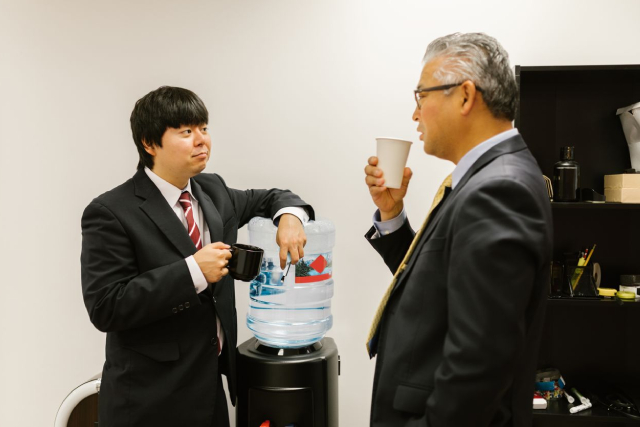
Every office has a version of this debate. Somebody points out that the bottled water invoice has crept up again. Somebody else mentions that the storeroom is full of empties. A third person suggests looking into a piped-in unit, and then nobody does anything about it for another six months because comparing the two properly seems like a chore.
It takes about fifteen minutes, actually. The comparison only looks complicated because the two options present their costs differently. Bottled delivery bills you per bottle, so the cost rises with consumption and stays invisible in the storeroom. A rental bills you a flat monthly fee that covers almost everything. Working out whether a water dispenser for the office beats your current delivery comes down to volume, and volume is something you can estimate on the back of an envelope.
Start With Your Monthly Volume
Everything else follows from this number, so get it first.
A reasonable planning figure is 1.5 litres per person per working day, which accounts for drinking water plus tea and coffee. Multiply by your headcount and by roughly 22 working days a month.
For a 30-person office, that comes to about 1,000 litres a month. Adjust down if half your team works from home midweek, and up if you have physical work, a warehouse, or a steady stream of visitors.
Now you have something concrete to price both options against.
What Each Option Costs
Here is the structure of both bills:
| Cost line | Bottled delivery | Piped-in rental |
| Per-litre charge | Per bottle, scales with usage | None |
| Equipment | Cooler rental or loan | Included in monthly fee |
| Delivery | Per drop, sometimes with a minimum order | None |
| Filters | Not applicable | Included in most plans |
| Servicing | Varies, often chargeable | Included in most plans |
| Electricity | Yes, for the cooler | Yes, similar draw |
| Water | None | Small, metered |
| Bottle deposits | Yes, refundable | None |
For that 1,000-litre office, bottled delivery in 18.9L bottles means around 53 bottles a month. Multiply 53 by whatever your supplier charges per bottle and you have the recurring figure. If your office runs on cartons of 500ml bottles instead, the same volume becomes roughly 2,000 individual bottles a month, which is where the per-litre cost climbs sharply.
Against that, a rental is one monthly fee plus two small utility lines. Electricity is the larger of the two. Singapore’s regulated tariff for July to September 2026 is 31.91 cents per kWh before GST, so a unit drawing roughly a kilowatt-hour a day adds around ten dollars a month. The water itself, at about a cubic metre a month, costs a couple of dollars.
The arithmetic tends to resolve quickly. Bottled delivery scales linearly with headcount, and a rental barely moves.
The Costs That Never Appear On The Invoice
This is where bottled delivery quietly gets expensive, and none of it shows up in the accounts.
- Storage – Fifty-three full bottles plus a buffer take up floor space, and commercial rent in Singapore is not cheap per square foot. Empties need somewhere to sit too, usually the same corner.
- Lifting – A full 18.9L bottle weighs close to 20kg and has to be hoisted onto a cooler. Someone in your office is doing that repeatedly, often without training, and shoulder and back strain from awkward lifting is entirely avoidable.
- Admin – Someone counts stock, places orders, chases late deliveries, reconciles deposits, and handles the invoice. Two hours a month of a coordinator’s time is a real cost even though it never gets billed.
- Running dry – Offices on bottled delivery run out. It happens on a Friday afternoon before a long weekend, and someone ends up at the supermarket.
- Disposal – Cartons of small bottles create a waste stream you then have to manage. NEA reported Singapore’s domestic recycling rate at 11 per cent in 2025, with plastics recycling declining, so most of what leaves your pantry is being incinerated.
The rise of water refill stations across Singapore reflects how quickly the default has shifted away from carrying bottles around, and offices have followed the same pattern for much the same practical reasons.
Where Bottled Delivery Still Makes Sense
It is a genuine option in a few situations, and pretending otherwise is unhelpful.
Bottled delivery works when you have no plumbing access, which rules out some older shophouse units and certain co-working arrangements. It works for short leases, since there is nothing to install and nothing to uninstall. It works for events, site offices, and temporary premises. It also works during power outages, because a bottled cooler with a manual tap still dispenses.
Very small offices land somewhere in the middle. A team of five drinking 165 litres a month may find the two options close enough that convenience decides it.
Finding The Crossover Point
The rough pattern looks like this. Below about ten people, the monthly figures are often comparable and the decision comes down to whether you have a water point available. Between ten and thirty people, piped-in rental usually pulls ahead on the invoice alone, before you count the storage and admin. Above thirty, the gap widens every month and the hidden costs start to dominate.
Three questions settle it faster than a spreadsheet:
- How many bottles did you order last month, and what did each cost?
- Is there a water point and a socket within reach of your pantry?
- How long is left on your lease?
If your monthly bottle count multiplied by the unit price exceeds a rental quote, and you have plumbing access, the decision has already made itself.
One caution on rental quotes: Confirm what the fee covers, how many filter changes are included annually, whether the contract auto-renews, and what happens if you relocate mid-term. A cheap headline fee with chargeable servicing can end up costing more than a slightly higher all-inclusive plan.
Conclusion
Count last month’s bottles, multiply by the price, then ask two or three suppliers for an all-inclusive monthly figure covering installation, filters, and servicing. Compare the totals across 24 months instead of one, because that is the horizon where storage and admin savings show up properly.
If you would like a quote to compare against your current delivery bill, Watermaxx supplies, rents, services, and repairs piped-in dispensers, water coolers, and boilers for businesses and homes across Singapore, from compact three-temperature models for small teams to heavy-duty units for sites of 100 people and more. Every unit comes with a four-stage filtration system, our own technicians handle servicing, and we offer a free, no-obligation site visit to confirm your connections before you commit to anything.