
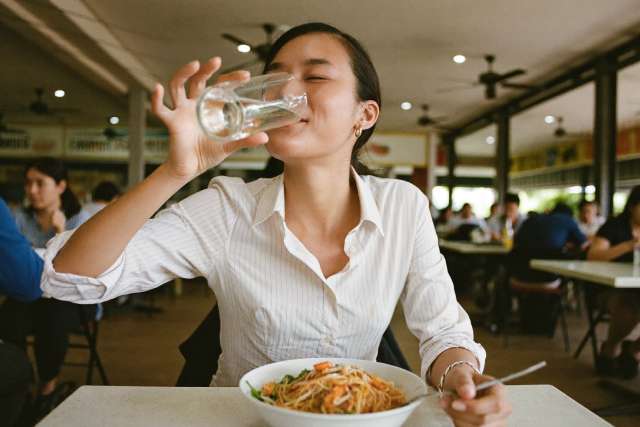
Char kway teow at noon, back at the desk by one, and by three you have already drained your bottle and still feel dry. That familiar afternoon thirst after a hawker centre lunch is not your imagination, and it has rather less to do with the tropical heat than most people assume.
Salt is doing most of the work. Singaporean cooking leans on soy sauce, fish sauce, stock, belacan and preserved vegetables for its depth, and every one of them carries sodium. Your body responds by moving water around to keep things in balance, and the signal it sends back is thirst.
Why salty food make you so thirsty
Sodium changes the balance of fluid inside and outside your cells, so your body asks for water to restore it. When you eat a salty meal, sodium levels in your blood rise slightly, and your brain responds by triggering thirst and by holding on to more of the fluid you already have.
That is a normal, healthy process and not a warning sign. The discomfort creeps in when you ignore the signal for a couple of hours because you are heads-down on a deadline, and there is nothing to drink within arm’s reach. Having a water cooler a short walk from your desk removes the small friction that stops most people topping up, which sounds trivial until you notice how much more you drink once the walk takes ten seconds instead of two minutes.
How much sodium do people in Singapore eat?
Singapore residents take in an average of 3,620 mg of sodium a day according to Health Promotion Board figures from the National Nutrition Survey, while the World Health Organisation recommends staying under 2,000 mg, roughly one teaspoon of salt. Nine in ten residents go over that limit. Most of it never comes from the shaker on the table but from sauces, soups and seasonings already cooked into the food, which is why a plate can taste perfectly balanced and still be salty enough to have you reaching for a drink an hour later.
Why the thirst creeps up slowly instead of hitting at once
Thirst usually lags behind the meal because sodium takes time to move into your bloodstream and reach the sensors that trigger it. You feel completely fine walking back from the hawker centre, then noticeably parched an hour or two later.
Singapore’s climate stretches that gap further. Moving between an air-conditioned office and the afternoon heat means steady fluid loss through perspiration you barely register, so the deficit builds from two directions at once and neither one announces itself. The air-conditioning is the sneakier of the two, because dry cooled air pulls moisture from your skin and your breath all afternoon without ever making you feel hot.
Then there is what you drink alongside the meal. Kopi, teh and bubble tea all contribute to your fluid intake, though the sweeter ones tend to leave you reaching for another sip fairly quickly. Coffee counts towards your daily fluids too, a point the guide to workplace hydration sets out in detail, but a glass of plain water alongside it does far more for that dry, scratchy feeling at four o’clock.
What helps you stay comfortable until knock-off
Small habits work better than heroic gulping at teatime. If you spread the intake across the afternoon, the thirst never really gets a chance to build, and you avoid the uncomfortable business of drinking half a litre at five and then regretting it on the train home.
- Fill your bottle before you sit back down after lunch, so the first few sips happen while you are still thinking about it.
- Ask for less gravy or sauce where the stall is happy to oblige, and leave the last of the soup in the bowl.
- Pair a sweet drink with a glass of plain water instead of treating it as a choice between the two.
- Keep water-rich fruit such as watermelon, papaya or cucumber in the pantry fridge for an afternoon snack.
- Use a glass you can see through instead of a lidded flask, since something visible on the desk tends to get finished faster.
Does this mean giving up hawker food?
Not in the slightest. Hawker food is part of daily life here and enjoying it does not require a spreadsheet or a sense of guilt. HealthHub suggests around eight glasses of fluid a day as a general guide for adults, with pale, odour-free urine as the simplest at-a-glance check that you are getting enough.
What changes is the drinking around the meal, not the meal itself. If you eat out most days, the gentlest adjustment is making plain water the default between meals, so a salty lunch never has to be made up for in one desperate stretch before you clock off.
Give it a fortnight and the pattern usually shifts on its own. The three o’clock slump softens, the mid-afternoon headache turns up less often, and you stop noticing the thirst at all, which is rather the point. None of that requires eating differently, only drinking a little more deliberately around the meals you already enjoy.
Conclusion
Staying comfortable through a Singapore afternoon comes down to how easy the next glass is to reach. At Watermaxx, we help homes and offices set that up properly, with filtered hot and cold drinking water on tap and after-sales support that does not vanish the moment the unit is installed.
If you would like to talk it through, we offer a free, no-obligation site visit and quote, and our team is happy to advise on what suits your space and the number of people using it. Give us a call and we will take it from there.