
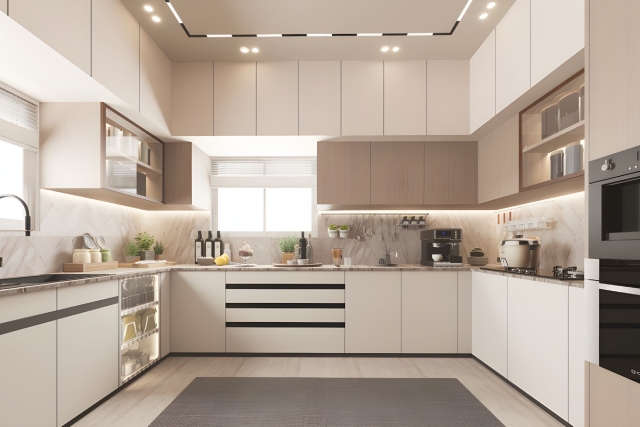
For decades, the work triangle (the imaginary line connecting your hob, sink, and refrigerator) was the golden rule of kitchen design. Every interior designer worth their portfolio swore by it, and every homeowner renovating their flat tried to honour it. The idea was simple: keep your three most-used kitchen zones close together and you’d have an efficient, functional kitchen. It made sense for its time.
But kitchens have changed. The way Singaporeans cook and live at home has shifted considerably, and the work triangle, as a design philosophy, hasn’t kept up. In 2026, the most thoughtfully designed kitchens aren’t optimised around the hob and sink. They’re built around how people actually start their mornings, feed their families, and gather in the spaces they share. And increasingly, that means something the work triangle never accounted for: the beverage station.
How the HDB dry kitchen changed everything
The rise of the dry kitchen concept in Singapore HDB and condominium renovations has quietly dismantled the logic of the work triangle. For those unfamiliar, a dry kitchen is a secondary kitchen space used for light food preparation, beverages, and breakfast routines, while the wet kitchen handles heavy cooking, wok hei, and anything that produces smoke or splatter.
This split-kitchen approach has been gaining momentum for good reason. According to HDB’s latest living trends data, open-concept layouts remain one of the most requested renovation configurations among flat owners. The desire for a more connected, airy living space has pushed heavy cooking firmly behind closed doors and brought the beverage and breakfast routine front and centre.
When your dry kitchen is visible from the living room and connected to your dining table, it becomes a design statement as much as a functional space. That changes what you put in it, and how you design around it.
The beverage station: Function meets lifestyle
The beverage station, sometimes called a coffee nook or morning bar, is the natural evolution of the dry kitchen. Rather than a general-purpose countertop that tries to do everything, it’s a dedicated zone designed around one specific ritual: the morning (and afternoon, and evening) drink routine.
Done well, a beverage station handles your coffee, your tea, your filtered water, and your family’s various hydration habits without anyone having to crowd around a single sink or wait for a kettle to boil. It keeps that routine completely separate from meal preparation, which means two people can be doing different things in the kitchen simultaneously without getting in each other’s way.
A well-designed beverage station also makes it genuinely easier to drink more water, even if you dislike it, because when cold, filtered water is instantly available at the touch of a button, hydration stops feeling like a chore and starts feeling like the obvious choice.
Why the tankless dispenser is the anchor appliance
Ask any designer who has fitted out a modern dry kitchen what the anchor appliance of a beverage station should be, and the answer has shifted decisively in recent years: it’s the tankless water dispenser.
Here’s why it works so well in this context. A traditional kettle takes up counter space, needs to be filled manually, takes time to boil, and has to be moved when you need the counter for something else. A dispenser with a tank is bulkier and requires its own footprint. A tankless point-of-use dispenser, connected directly to your water supply and plumbed in neatly, eliminates all of those problems at once.
You get instant hot water for your morning kopi, cold filtered water throughout the day, and in many models, ambient or warm water settings in between, all from a slim unit that sits cleanly on the counter or can be built into cabinetry for a seamless look.
For families with young children, the safety features on modern tankless dispensers, child locks on hot water functions, for instance, add another layer of practicality that a traditional kettle on an open countertop simply can’t offer.
What the best beverage stations have in common
Whether you’re working with a small HDB dry kitchen or a more spacious condominium layout, the most functional beverage stations tend to share a few design principles.
- They keep everything within arm’s reach
The dispenser, the cups, the coffee or tea supplies; ideally, all within a step or two of each other, so the morning routine flows without unnecessary movement.
- They separate wet and dry functions
Even within a dry kitchen, having a small, dedicated sink nearby is useful for rinsing cups and topping up ice, but it doesn’t need to be the focal point. The dispenser handles the hot and cold water; the sink is a supporting player.
- They’re designed to be seen
Unlike a wet kitchen that’s hidden behind a door or a partition, a beverage station in an open-concept layout is part of the home’s visual identity. Cohesive finishes, integrated appliances, and thoughtful storage make the difference between a corner that looks purposeful and one that looks cluttered.
- They scale with the household
A single professional’s beverage station looks different from a family of five’s, but the principle is the same. Design around the actual drinks your household makes and consumes, and let that drive the layout and appliance choices.
The work triangle had a good run
It genuinely did. For the kitchens of the past, the work triangle was sound logic. But the kitchen of 2026 is a social space and increasingly, a design feature in its own right rather than a room to be hidden away.
The beverage station isn’t a trend that will fade when the next renovation cycle comes around. It’s a response to a genuine shift in how Singaporean households use their kitchens, and the tankless dispenser, as its anchor appliance, is one of those rare additions that improves both the form and the function of a space simultaneously.
Conclusion
At Watermaxx, we offer a range of tankless and countertop water dispensers perfectly suited to modern kitchens in Singapore: slim, efficient, and designed to complement contemporary dry kitchen aesthetics. Whether you’re mid-renovation or simply looking to upgrade your current setup, our team can help you find the right model for your space, your household, and your daily routine. Visit us at Watermaxx to explore our full range and take the first step towards a kitchen that works the way you actually live.