
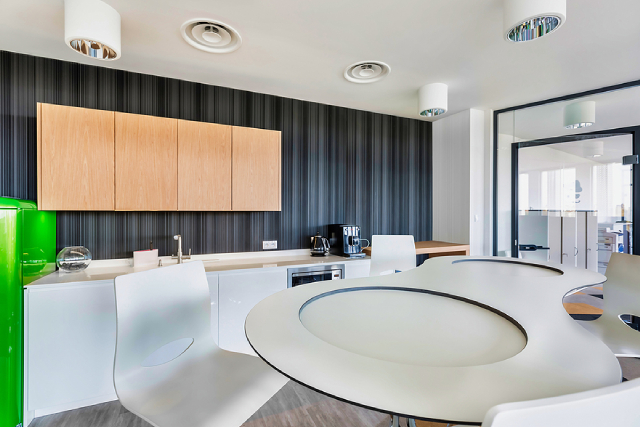
Most offices decide where the dispenser goes in about ninety seconds. Someone points at a gap near the pantry wall, the installer nods, and that is where it stays for the next four years. Nobody revisits the decision, partly because it feels too small to bother with. Yet placement quietly determines how much your team drinks, how often the unit needs cleaning, and whether anyone complains about the noise during Monday morning calls.
The encouraging part is that good placement follows a handful of practical rules, and none of them requires a floor plan or a consultant. You are balancing four things at once: where people naturally walk, where the power and water connections already sit, how much clear space the machine needs around it, and whether anyone is going to trip over a puddle. Position a water dispenser for the office with those in mind and usage tends to look after itself.
Follow The Natural Traffic, Not The Floor Plan
Every office has desire lines, the routes people take without thinking. The walk from the lift to the desks. The path to the printer. The loop to the toilets. Put the dispenser on one of those routes and refilling becomes something people do in passing. Put it somewhere that requires a deliberate detour and refill frequency drops, quietly and permanently.
Watch your own floor for a day and note where people slow down. Common winners include the corridor outside the pantry, the stretch beside the printer, and the space near a shared meeting room. Common losers include the far end of a quiet department, a room that gets booked all day, and any spot that means walking past the boss’s desk twice.
Distance affects intake. When getting water requires effort, people put it off, and in Singapore’s climate that adds up faster than most of us expect. The dangers of on-the-job dehydration arrive quietly as well, showing up as headaches and poor concentration long before anyone feels properly thirsty.
Power And Plumbing Set The Boundaries
Ideas about placement often collide with reality once the installer arrives. Piped-in dispensers need three things nearby, and all three limit your options more than the aesthetics do.
- A water point: Usually a tap connection in the pantry or a toilet riser. Long runs of tubing are possible but add cost and create more joints that can leak.
- A dedicated power socket: Sharing an extension lead with a microwave and a kettle invites tripped breakers. A wall socket within reach of the unit’s cable is ideal, since running cables across a walkway creates a trip hazard.
- Drainage: Some models need a drain point for the drip tray or flushing. Without one, someone has to empty a tray manually, which is a task that gets forgotten by Thursday.
Ask your supplier to walk the floor before committing. A ten-minute site visit usually reveals that your preferred wall has no socket and the wall opposite has both.
Give The Unit Room To Breathe
Dispensers need clearance on more sides than people assume, both for ventilation and for the person filling a bottle. Cramming a floor-standing unit into an alcove restricts airflow around the compressor, which makes the cooling work harder and shortens the machine’s life.
| Side | Rough clearance to aim for |
| Back | 10cm to 15cm for ventilation |
| Sides | 10cm each, more if between cabinets |
| Front | 80cm to 90cm so two people can pass |
| Above | Enough headroom for a tall bottle under the tap |
That front clearance is the one most offices get wrong. If the dispenser sits in a 90cm corridor, one person filling a bottle blocks the entire route, and you have created the queue you were trying to avoid.
Spacing Across A Larger Floor
Once you go past roughly 50 staff or a single large floor plate, one unit stops being enough regardless of how well you place it. The aim then becomes coverage instead of position.
Split the floor into zones and give each zone its own access point, keeping the walk under about 30 seconds from any desk. On a long, narrow floor, units at opposite ends beat two in the middle. Where departments have different rhythms, place a unit closer to the people who cannot leave their seats easily.
The Safety Points People Skip
Two of these are regulatory, and both are easy to get wrong.
Water and floors are a known hazard. The Workplace Safety and Health Council reports that slips, trips and falls account for more than a quarter of all workplace injuries, affecting thousands of employees a year. Placing a dispenser on carpet tile or textured vinyl helps, as does keeping a small mat and a cloth nearby. Avoid polished stone directly in front of the tap.
The second is escape routes. Under the SCDF Fire Code, exit access doorways must be kept clear and unobstructed at all times. A dispenser parked beside a fire door or narrowing an escape corridor is a compliance problem as much as a practical one. Keep units out of exit passageways and away from riser cupboards and hose reels.
Small Details That Change Usage
A few finishing touches make a surprising difference to how often people use the unit:
- Put a bin within arm’s reach – Without one, cups collect on top of the machine.
- Provide cups or a bottle rack – Staff who have to walk back to their desks for a cup often skip the trip entirely.
- Keep it out of the sightline of a manager’s screen – People linger less when they feel watched.
- Mind the noise – Compressors cycle audibly, so a unit directly outside a glass meeting room becomes an irritation on calls.
- Leave the display visible – Temperature indicators and filter reminders are useless facing a wall.
Conclusion
Walk your floor, mark the two or three spots that sit on a natural route with power and water nearby, then check the front clearance and the nearest fire door before deciding. Fifteen minutes of walking beats a year of a badly placed machine.
If you would like help sizing and siting a unit, Watermaxx supplies, rents, services, and repairs piped-in dispensers, water coolers, and boilers for workplaces across Singapore, from compact three-temperature models for small teams to heavy-duty units for sites of 100 people and more. Every unit comes with a four-stage filtration system, and we offer a free, no-obligation site visit so we can look at your layout and recommend the connections and positions that will work. Call or email us to arrange a visit.