
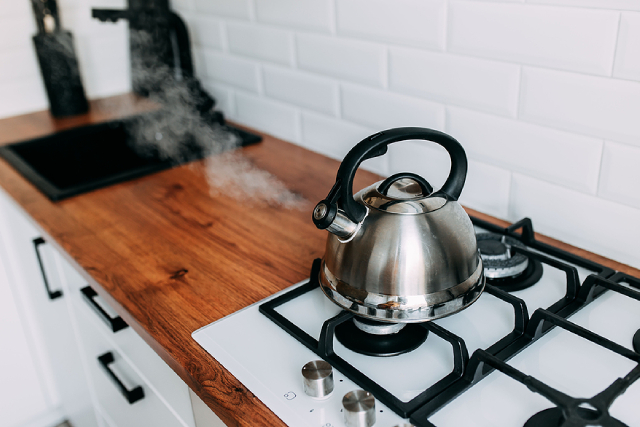
Plenty of offices still run entirely on a kettle. It sits on the pantry counter, somebody fills it, somebody else boils it, and the arrangement has worked well enough for years. Suggesting a dispenser usually prompts the same reasonable question: why pay a monthly fee for something a thirty-dollar appliance already does?
Fair question, and the answer is more interesting than either side usually admits. On electricity alone, the two are closer than most sales pitches suggest. Where a hot and cold water dispenser pulls clearly ahead is on the things nobody puts on an invoice, meaning waiting time, chilled water, and the small daily upkeep that quietly falls to whoever is nearest the pantry. Here is the arithmetic, with the tariff figures made explicit so you can redo it for your own office.
The Electricity Question, Answered
Boiling water needs a fixed amount of energy, and no appliance escapes that. Raising 1.7 litres from room temperature to boiling takes roughly 0.15 kilowatt-hours, so a full kettle costs about the same to boil whichever brand sits on your counter.
Singapore’s regulated electricity tariff for July to September 2026 is 31.91 cents per kWh before GST, or 34.78 cents including it. Put those numbers together for a modest office running a dozen full boils a day:
| Kettle | Piped-in dispenser | |
| Energy pattern | On demand, per boil | Standby draw, holds temperature |
| Rough daily use | About 2 kWh at 12 boils | About 1 to 1.5 kWh, model dependent |
| Monthly electricity | Roughly $15 over 22 working days | Roughly $10 to $16 |
| Water cost | Metered as normal | Metered as normal, similar |
| Equipment cost | Low, replaced every few years | Monthly rental or purchase |
So on power, it is close to a draw. The kettle wins on paper if your office boils rarely, and the dispenser wins if your team reboils constantly, which most do. Kettles get overfilled for one cup and reboiled once the water cools, and that waste is where the figure creeps up.
Several of the innovative features in water dispensers target this directly, with sleep modes and better tank insulation cutting the standby draw overnight and across weekends. For an office closed 128 hours a week, that is a substantial share of the total.
Where The Time Goes
This is the line that changes the answer.
A two-kilowatt kettle takes four to five minutes to bring a full load to the boil from cold. A dispenser delivers hot water in about five seconds. That difference sounds trivial until you multiply it.
Take a 20-person office where each person makes two hot drinks a day. If half of those occasions involve waiting for a kettle, three minutes each adds up to roughly an hour of collective standing about per day, or around 20 hours a month. Treating that as lost money would be a stretch, since people chat and think while they wait, but it stacks up in queues at predictable moments.
The queue is the sharper problem. Kettles serve one batch at a time, so a mid-morning rush means three or four people waiting through another boil cycle. Dispensers hand out cups continuously until the tank needs recovery, a much shorter bottleneck.
The Gap Nobody Mentions
Kettles do one thing. They deliver hot water, and only hot water.
Singapore’s climate makes chilled water the more frequently wanted option for most of the working day, and a kettle offers nothing there. Offices running on kettles alone fill the gap with a fridge full of bottles or a supermarket run, reintroducing the cost and storage problem you hoped to avoid.
A three-temperature unit covers ambient, chilled, and hot from the same tap. Comparing a kettle against that is comparing one function against three, which is the part the electricity table cannot capture.
Daily Upkeep, Side By Side
Both need attention. The difference is who gives it.
With a kettle, the work sits with your team. Someone refills it, someone descales it, someone notices when the element starts labouring, and someone replaces it every couple of years. None of it takes long, and all of it lands on whoever cares most, usually the same person every time.
With a rented dispenser, servicing and filter replacement generally sit with the supplier. Your team wipes the tap area and empties the drip tray. Filter changes arrive on a schedule you do not have to manage, which for a busy office removes a recurring small task from somebody’s plate.
Safety And The Small Stuff
A brief mention here, because it applies at home as much as at work: Kettles hold an open volume of boiling water at counter height, and KKH reports that scalds accounted for 71 per cent of paediatric burn injuries in 2024, with up to 400 children treated annually. If your workplace has visiting families, or you are weighing the same decision for your own kitchen, a dispenser with a hot water safety lock removes that exposure entirely.
A few other practical differences:
- Filtration – A kettle boils whatever comes out of the tap, chlorine taste included. Boiling does not remove it.
- Limescale – Kettles accumulate deposits that end up in your cup. Filtered units reduce the input.
- Counter space – A kettle plus a fridge full of bottles occupies more room than one floor-standing unit.
- Cables – Kettles need a socket on the counter, which in a small pantry usually means an extension lead.
When A Kettle Is Still The Right Call
There are clear cases, and pretending otherwise would be silly.
A kettle suits teams of about five or fewer, offices on very short leases, premises with no water point available, and situations where hot water is all anyone needs. It also has the advantage of costing almost nothing to start with, which is a consideration when a new business is watching every outgoing.
The picture changes at somewhere around ten to fifteen people, where the queue becomes noticeable, the demand for cold water becomes constant, and the upkeep starts falling repeatedly on the same colleague.
Conclusion
Count your headcount, note how often the kettle actually gets reboiled, and be honest about how much cold water your team buys separately. Electricity will be close either way. The decision usually turns on queues, chilled water, and whose job the upkeep becomes.
If you would like a figure to compare against your current setup, Watermaxx supplies, rents, services, and repairs piped-in dispensers, water coolers, and boilers for offices and homes across Singapore, from compact three-temperature models for small teams to heavy-duty units for sites of 100 people and more. Every unit comes with a four-stage filtration system, our own technicians handle servicing and filter changes, and we offer a free, no-obligation site visit to check your pantry connections first. Call or email us today for a quote!