
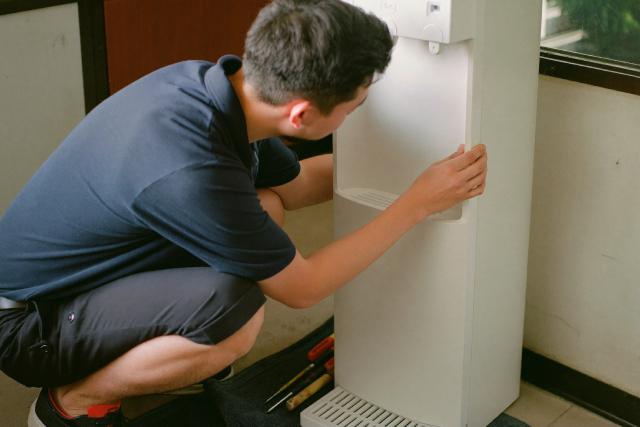
Monday morning, the office kettle has gone because somebody decided the dispenser made it redundant, and the hot tap is now producing something closer to bathwater. Everyone has an opinion about whether it can be fixed, and nobody wants to be the one who signs off on a new unit unnecessarily.
The repair-or-replace call is easier than it looks once you know which faults are routine and which ones point to something reaching the end of its life. Most units fail in fairly predictable ways.
What usually goes wrong with a water dispenser?
The common faults fall into a small number of categories: heating or cooling that no longer reaches temperature, leaks around fittings and the drip tray, taps that drip or stick, unusual noise from the compressor, and a change in taste or odour that a filter change does not resolve.
Temperature complaints are by far the most frequent. A hot tap that has gone lukewarm or a cold tap producing water at room temperature usually points to a thermostat, a heating element or a cooling component, and all of them are serviceable parts on most units.
Taste and odour changes deserve investigating properly before anyone assumes the worst. Filters have a working life, and a saturated carbon filter stops doing its job long before anything looks wrong from the outside, so a change of filters is the sensible first move.
Which problems are usually a straightforward repair?
Most faults on a unit that is otherwise in good condition are repairable, often in a single visit. A qualified technician handles this sort of thing regularly:
- Replacing a worn tap, valve or seal that has started dripping.
- Swapping out a failed thermostat or heating element.
- Clearing and resealing fittings where a slow leak has developed.
- Replacing saturated sediment, carbon or UF membrane filters.
- Descaling a hot tank where mineral deposits have built up over time and started affecting performance.
A water dispenser repair service will usually diagnose on site, which saves the guesswork entirely. Our technicians handle most brands on the market and not only our own, so an ageing unit from another supplier is never automatically a write-off.
When does replacing make more sense?
Replacement becomes the better call when the fault sits in a major component, when the same problem keeps returning, or when spare parts for the model are no longer available. A compressor failure on an older unit is the classic example, since the repair cost approaches the value of the machine and the rest of the unit is exactly the same age.
Repeat faults are the other clear signal. One repair is maintenance and two is bad luck, but a third visit for the same underlying issue usually means the unit is telling you something. At that point the running cost of keeping it alive quietly overtakes the cost of starting fresh, and the disruption to a household or an office adds up alongside it.
Usage patterns feed into the decision as well. A unit that serves two people at home has a very different life expectancy from one running all day in a busy pantry, so the same fault on the same model can point in opposite directions depending on where it has been working. Any unit that has started leaking around internal fittings rather than at a tap deserves a careful look, since water finding its way into the wrong part of a machine rarely improves on its own.
How age changes the calculation
Age shifts the maths because components wear at similar rates. On a unit that has been in daily service for many years, fixing one failed part often just moves the queue along to whichever component was next in line, and you end up paying for a series of visits instead of making one decision. Newer units with a single isolated fault are almost always the better candidates for repair.
What to check before you call anyone
A few checks take two minutes and occasionally save a call-out entirely. Confirm the unit is switched on at the socket and that nothing has tripped, check the water supply is open, and look at whether the filters are overdue for a change. More faults than you would expect turn out to be a switch someone knocked while cleaning.
Note down what you observe as well, because it makes the diagnosis faster when someone does come out.
- When the problem started and whether it came on gradually or all at once.
- Whether it affects the hot side, the cold side or both.
- Any sounds, smells or visible water around the base of the unit.
- The model and roughly how old it is, along with when it was last serviced.
If you are weighing up a replacement anyway, the innovative features in water dispensers available now sit a fair distance ahead of what was standard a decade ago, which sometimes tips a borderline decision. Better filtration staging, quieter operation and more precise temperature control all make a noticeable difference in daily use.
Conclusion
Fix what is isolated and recent, replace what is systemic and old, and get a proper diagnosis before deciding either way. A five-minute look from someone who knows the machine beats a fortnight of debate in the office chat.
At Watermaxx, we service, maintain and repair units for homes and businesses across Singapore, including brands we did not supply ourselves, and we only take payment once the job is done to your satisfaction. Contact us for a free, no-obligation site visit and quote, and we will tell you honestly what we find.