
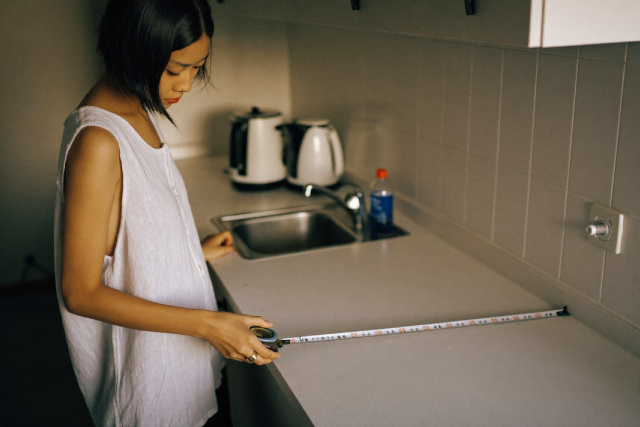
Anyone who has measured a kitchen corner with a phone screen knows the feeling. The unit will fit, technically, but only if the rice cooker moves, the bin goes somewhere else and nobody ever opens that bottom drawer again.
Placement is the part people think about last and regret first. Getting it right in a compact flat is less about finding a gap and more about understanding how the household actually moves through the space during a normal Tuesday evening.
What to check before you decide on a spot
Three things settle most of the decision: a nearby power point, access to a water supply, and enough clearance around the unit for airflow and for cleaning behind it. Every other consideration is secondary to those.
Direct pipe-in units connect to your existing water supply, so the practical question becomes how far the spot sits from a usable connection point. A kitchen sink or a service yard tap is usually the easiest, though a competent installer can often work with a longer run if the layout demands it. A home water dispenser placed sensibly on the first attempt saves the small indignity of moving it three months later.
Clearance is the one people forget. A unit shoved hard against a wall on both sides has nowhere to shed heat, and you will not enjoy trying to wipe the floor behind it when something inevitably drips. A few centimetres at the back and one accessible side is usually enough, and it makes the difference between a five-minute clean and shifting furniture every time a filter needs changing.
Is the kitchen always the best place?
The kitchen is the obvious choice and often the right one, but not automatically.
Kitchens in smaller flats already compete for counter space with the airfryer, the kettle and the drying rack, and a dispenser tucked into the busiest corner of the home tends to get bumped, splashed and treated as somewhere to put things down. A dining area, a service yard entrance or the end of a hallway can work just as well, and in a flat where the kitchen is closed off from the living room, moving the unit outside it often doubles how often anyone uses it.
Placing it where people walk past
Visibility drives how much people drink, which is the whole point of having one. A dispenser in a spare room stops being used within a fortnight, no matter how sensible the plumbing was, and the household quietly goes back to the kettle and the fridge.
Think about the routes everyone takes without thinking. The path between the bedrooms and the kitchen, the corner beside the dining table, the bit of wall near where the children do their homework. Somewhere on those routes usually beats a technically perfect but out-of-sight position, and the same logic applies to kitchen appliances generally, which get used in proportion to how visible they are.
Common placement mistakes in a compact flat
Most regrets come down to the same handful of decisions, all of which are easy to avoid at the planning stage and awkward to undo once the unit is plumbed in and sitting where it is.
- Putting it in direct afternoon sun from a west-facing window, which makes the unit work harder than it needs to.
- Choosing a spot with no drainage nearby, so every drip tray emptying becomes a trek across the flat.
- Blocking a cupboard, a door swing or the washing machine hatch that nobody remembered was there.
- Sitting it on an uneven floor, which causes rocking and eventually leaks around the fittings.
- Sharing an already-overloaded power point with three other kitchen appliances.
Do you need a plumber or a power point nearby?
You will need a standard power point within reach and a water connection the installer can work with, and both are usually straightforward in an HDB flat. Trailing an extension cord across a walkway is not a solution, and the electrical side deserves sorting out properly at the point of installation.
Water quality is rarely the deciding factor for placement. Singapore’s tap water is regulated to standards based on World Health Organisation guidelines and tested extensively by PUB before it reaches your flat, so the filtration on a dispenser is about taste, odour and convenience. The sediment filter catches particulates, the pre and post carbon filters adsorb chlorine and the compounds that affect taste, and the 0.1 micron UF membrane filter excludes bacteria and larger particles.
Older flats occasionally throw up a surprise, usually an awkward pipe run or a socket in an unhelpful position. That is exactly the sort of thing a site visit uncovers in five minutes, and it is far cheaper to discover before the unit arrives than after somebody has started drilling. Renovated flats can be trickier still, since a boxed-in pipe or a rerouted supply is invisible until an installer goes looking for it, so photographs of the space alone rarely tell the full story.
Conclusion
The best position is the one your household walks past twenty times a day, with power, water and a bit of breathing room around it. Line those four things up and the rest sorts itself out.
Our team at Watermaxx does free on-site consultations precisely because layouts differ so much from flat to flat, and what works in a four-room maisonette rarely translates to a two-room. Contact us for a free, no-obligation site visit and quote, and we will look at your space together before anything gets installed.